
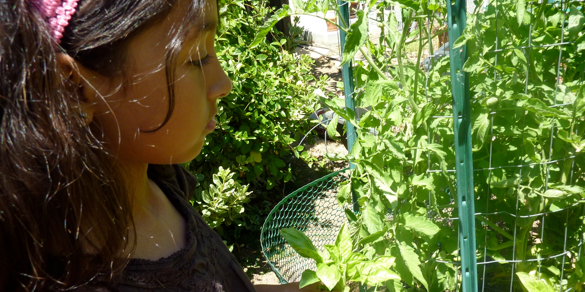
Backyard farming -- hard work, but our reward is the delight in watching sweet treasures grow.
Mother Nature has teased us relentlessly this spring – one day it looks like warm temperatures are here to stay, the next we’re back to donning woolly sweaters and downing mugs of hot soup. With this roller coaster weather has come uncertainty about spring planting. Normally gardens would be firmly established by now, showing signs of steady growth. With the thermometer dipping into the forties some nights, and barely reaching sixty some days, we’ve put our seedlings in with hesitant fits and starts. As Memorial Day looms on the horizon, we can delay no longer. This weekend, our planting finished, we’ll cross our fingers while making an impassioned plea to the heavens, and hope that sustained growing weather arrives soon.
One thing we can count on is a bountiful Freshness Farms delivery each week, and you may well wonder what additional value a backyard garden offers that would justify the hard work (and potential frustration) involved. After all, won’t our veggie bag provide more than enough produce? Pondering these questions takes me back to an earlier decade and a small apartment, squeezed in right next to the “L” train tracks in the heart of Chicago, its brick building surrounded by concrete, stone and more brick on all sides — to an era well before community garden plots, urban rooftop vegetable growing and local, sustainable eating had all found their way into the vocabularies (or at least on the radar) of average city dwellers like me. My closest link to gardening was a few small herb pots I managed to tend out on my backdoor fire escape. We’re not talking grow-your-own food – more like a few meager snips of basil now and then, if I was around enough to water regularly.
Moving out to California in the early nineties I was immediately astounded by the year-round growing season, and the cultivation going on in typical backyards. In our tiny Redwood City yard we had persimmon, orange, pear and lemon trees, plus a garden bed for raising vegetables and herbs. Amazing to us, this wasn’t the least bit unusual – a yard with no fruit trees or garden at all would’ve been.
Inveterate city dwellers though we were, my husband and I were quickly enthralled by the possibilities for backyard gardening. We didn’t really need to grow our own food – there was abundant fresh produce available, unlike anything we’d been used to back home. Yet we found our plot of dirt captivating – this was about more than just meals. Harvesting sugar snap peas for a stir-fry or juicing our sweet oranges moved us in a quite unexpected way. Perhaps the experience was merely about growing up and finding meaning beyond Happy Hour on Friday night, but I’m pretty certain there was something even bigger at work.
These many years later, as I watch our children tend the garden, I see similar enthusiasm. Clearly there is a joyful connection to be made, growing our own food – something apart from economics and need (though these can be satisfied too) that speaks to our very souls. I defy anyone to feel grumpy while juicing fruit plucked from a backyard tree to make fresh lemonade. It can’t be done, for love or money.
We’ve grown used to the spoils of our garden and think nothing of trotting out to the backyard, kitchen scissors in hand for a sprig of fresh rosemary to adorn roast potatoes or a lime to brighten homemade salad dressing. Occasionally I’m reminded of our good fortune, when an out-of-town guest comes to visit or on a sunny spring day when the perfume of orange blossoms permeates every corner of the yard. So, a long way round to answering those earlier questions – yes, backyard “farming” is hard work, sometimes fraught with moments of frustration and fatigue. But on most days, the pure delight offered is breathtaking, in its depth and sweet simplicity – a bit like raising children (in an abstract way). Is there value? Yes, indeed.
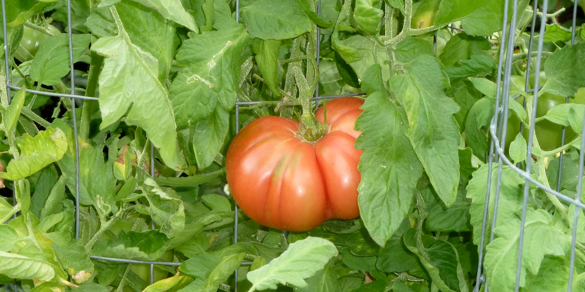
The super sweet simplicity of the huge mortgage lifter tomato (August, 2010)
If you haven’t yet tried gardening edibles, a great place to start is with a simple herb patch. You can dig right into the ground or in large pots on a patio. Start by picking a sunny spot – one that gets at least 6 hours of sun each day. Before planting amend the soil to provide a rich environment that will nourish your seedlings. Add all-purpose organic fertilizer, a hefty layer of organic compost (ideally the fruit of your own labor) and worm castings (a little goes a long way). Fork or dig your additions into the soil (if your soil has a high clay content, you may want to work in even more compost). Next, water and, ideally, allow the amendments to permeate the soil for a few weeks or more before planting. In May, we don’t have that luxury, so go ahead and plant your seedlings being mindful to allow space for future growth.
You’ll easily find herbs like basil, thyme, mint, parsley, rosemary and chives at your local garden store. Herbs are easy to start from seed, so if you’d like to try something more unusual, purchase a packet or two. Water twice a day until plants are well established, after that watering may be reduced to twice a week.
A few resources for great gardening tips:
•Trowel and Error: Over 700 Tips, Remedies and Shortcuts for the Gardener, by Sharon Lovejoy
•How to Grow More Vegetables, by John Jeavons
•Western Garden Book of Edibles: The Complete A-Z Guide for Growing your Own Vegetables, Herbs, and Fruits, by Editors of Sunset Magazine
•The One Block Feast: An Adventure in Food from Yard to Table, Margo True, Staff of Sunset Magazine
