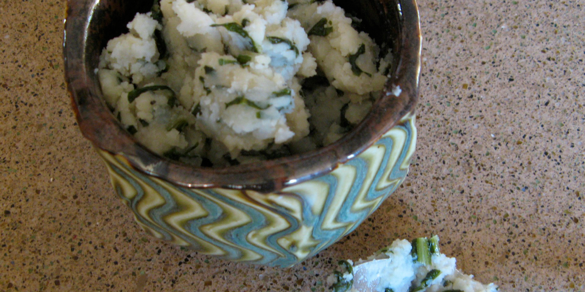
Green Mashed Potatoes

These creamy-tangy potatoes are inspired by Mark Bittman — a favorite food writer and regular in the NY Times. His recipe draws on the Italian tradition, mashing potatoes with olive oil and assertive dandelion. In Ireland the dish would be loaded with butter, cream and kale and called Colcannon (another classic — you can’t go wrong with potato in the mix). I’ve add sautéed onion and tossed the greens into the pan with the aromatics to deepen the flavors. Try throwing some cubed turnips into the pot if you have them.

Continue reading

Roasted Bell Pepper and Sun-dried Tomato Risotto

Though it takes some time to slowly incorporate the stock into risotto, it’s not difficult, and the reward is Italian comfort food at its very best. Risotto works well with most any veggies you have in the fridge or pantry. Try frozen peas, roasted winter squash, chopped greens, even basic staples likely to be found languishing in the crisper, like celery. Experiment by adding to this simple recipe or substituting for the roasted peppers or tomatoes. You can make a lovely, brightly colored beet risotto by adding up to a pound of peeled, finely diced raw beets to the onions (add some chopped celery too) and omitting the peppers. At the end of cooking, stir in a tablespoon or two of fresh lemon juice with the butter. Cheese is optional for this variation. You can omit the wine, but it does add lots of flavor and the alcohol burns off in cooking.

Continue reading

Root Vegetable Tarts

I’ve always liked working with frozen puff pastry, but this winter, I’ve gone a little crazy. There’s just so much you can do with the product. Concocting sweet or savory tarts, turnovers, appetizer bites, even pizzas, with such elegance, no one will believe you slapped it all together in less than an hour. The key for spontaneity, is to make sure you have some defrosted pastry waiting in the fridge – it will keep this way for a week, possibly more. You can also defrost the product on the kitchen counter fairly quickly, less than an hour depending on the brand – the Trader Joe’s version is ready in 20 minutes.

Continue reading

Lentil and Pinto Bean Chili

Lentil and Pinto Bean Chili

This dish draws inspiration from many sources—vegetarian chilis in Julee Rosso and Sheila Lukins, The Silver Palate Goodtimes Cookbook and Didi Emmon’s, Vegetarian Planet.  And there’s the Indian lentil stews I’ve learned to love over many years of marriage, like dal makhani which pairs lentils with kidney beans.  We’ve been experimenting and doctoring over years, each time we stir up this chili, we tweak it a bit, here and there.  The first version began with sautéed eggplant courtesy of the Silver Palate.  Years later, lentils and beer were added via Emmon’s suggestion, and somewhere along the line the spices that go into dal were stirred in.  If we have zucchini in the garden, we add it (toward the end of cooking).  Or carrots and celery.  Fennel even.  The beans we choose depend on what’s in the cupboard—cannellini, black, kidney and garbanzo are all able partners.

Though this chili is simple to prepare and can be on the table in an hour or so, it’s even better after a day or three, which allows the flavors to mingle, mellow and come together.

I like to grind my own spices—a trick I learned from my mentor in Indian cooking, my mother-in-law—since the flavor is far superior.  There’s a small coffee bean grinder stored in my cupboard, reserved just for spices.  Buy bags of cumin and coriander seed at an Indian market in bulk—the cheapest prices you’ll find anywhere.

We love Spanish pardina lentils here—they keep their shape as they cook, and have a lovely light brown hue—but substitute any earth-colored lentil.  French green lentils, lentilles du Puy, would be nice too. If you make a substitution, be sure to test the lentils for doneness, as each variety cooks at a different rate.  You may need to add more water too, depending on the variety.

Continue reading

Indian Spiced Tea (Masala Chai)

I’m sure it comes as no surprise, what we commonly know as Chai Tea (or Chai Tea Latte), ordered up at the local java house, is an Americanized version of the authentic Indian beverage. By the way, “chai” is the hindi word for tea, so when we ask for “Chai Tea”, we’re really saying we’d like some “Tea Tea”. When you want spiced tea in India you need to ask for Masala Chai (masala means spice) – order Chai and you might end up with plain black tea. Formulas for Masala Chai vary between households, and regionally. The ingredients I use are those preferred by my husband’s family (from whom I learned most of my Indian cooking technique) – lots of ginger, cardamom and clove (I sneak in a bit of cinnamon sometimes). Other families leave out the cardamom or add some crushed fennel seeds, even black pepper. Whatever formula you choose, spiced tea is served with lots of milk or cream and a healthy (unhealthy?) dose of sweetener (granulated white sugar is traditional, but I prefer agave nectar or turbinado sugar).

A quick trick (from my pal, Jane, who is also married to an Indian) that simulates the flavor of spiced tea without the work – break open one or two cardamom pods and add the pods, plus one broken clove to a tea mug. Add a black tea bag and boiling water. Steep for desired time, then remove tea bag (and spices if desired – though I just leave them in), add milk and sugar.

(serves 6)

Ingredients:

  • 6 cups water
  • 1/2 to one inch piece of ginger root, peeled and sliced into thin rounds
  • 8-10 green cardamom pods, lightly crushed to open the pods
  • 1-2 cloves broken in half
  • 1 very small piece of cinnamon stick (optional)
  • 4-5 black tea bags (or equivalent loose black tea)
  • 1/2 cup (or to taste) whole milk (warmed briefly in the microwave)
  • Sweetener of choice

Method:

  1. Place water and spices into a saucepan and bring to a boil on the stove. Reduce heat to medium-low, cover the pot and gently simmer for 5 minutes.
  2. Turn heat off, but keep pan on the burner. Place tea bags in the pan and cover. Steep for 4-5 minutes or as long as needed to achieve desired strength. Remove and discard tea bags.
  3. Add desired amount of milk to pot. Turn heat back on (very low) if necessary to keep tea warm.
  4. Using a small sieve or strainer to remove spices, pour tea mixture through strainer into a tea pot or other pitcher for serving.
  5. Serve in mugs with sugar or other sweetener on the side.